


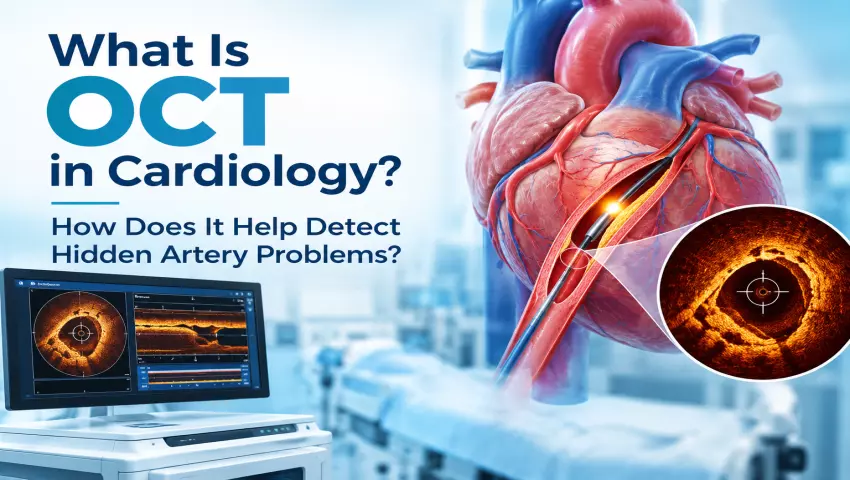
Heart disease is a major health concern today. When doctors check your heart, standard tests sometimes do not show the complete picture. If you consult the Best Cardiologist in Pune, they often look beyond basic scans and ask: What is OCT in Cardiology? How Does It Help Detect Hidden Artery Problems?
Optical Coherence Tomography (OCT) is a modern heart imaging test. It acts like a powerful camera that looks deep inside your blood vessels. It takes ultra-clear pictures of your artery walls, helping a leading Cardiologist in Pune spot hidden artery problems before they turn into serious heart attacks.
Understanding how OCT works can give you peace of mind if you or a family member need a detailed cardiac evaluation or treatment.
What Is OCT in Cardiology?
The OCT medical abbreviation in cardiology stands for Optical Coherence Tomography. It is a light-based test used to take clear, microscopic images inside the blood pipes (coronary arteries) of your heart.
Think of traditional X-ray Angiography in Pune like seeing the shadow of a tree—it shows the main shape, but not the small details. OCT is like taking a close-up photo of the tree bark.
Instead of sound or standard X-rays, OCT uses safe near-infrared light. It creates high-definition 3D pictures of the artery walls. Because of this, OCT in coronary artery disease helps doctors check fat buildup and artery health with extreme accuracy.
When OCT Is Used in Cardiology?
Doctors recommend OCT when non-invasive tests require further investigation to make a safe clinical decision.
When patients visit a Chest Pain Specialist in Pune, initial evaluations often start with basic scans. For example, a doctor might first order a 2D Echo Test in Pune to see the overall heart structure. In other cases, a treadmill Stress Test in Pune is performed to check how the heart works under pressure.
However, if these initial tests indicate severe blockages inside the blood vessels, advanced intravascular imaging becomes essential.
Common situations where OCT in cardiology is recommended include:
- Before placing a stent: To measure the exact length and width of the blocked pipe during an Angioplasty in Pune.
- Finding dangerous fat (plaque): To locate soft fat deposits that might burst suddenly.
- After placing a stent: To confirm the stent is fully open and sticking properly to the artery wall.
- Fixing old stent problems: To check why a previously placed stent got blocked again.
How OCT Helps Detect Hidden Artery Problems?
To fully understand what OCT in cardiology is. How Does It Help Detect Hidden Artery Problems? It helps to see how it overcomes the limits of basic tests. A basic angiogram shows where blood flow is slow, but it cannot see what is hidden inside the artery wall. OCT solves this problem in three simple ways:
1. Finding Soft, Dangerous Fat Deposits:
Fat inside an artery is covered by a thin skin (layer). If this skin is too thin, it can rupture and cause a sudden heart attack. OCT measures this thin skin accurately so doctors can treat it in time.
2. Spotting Microscopic Tears and Clots:
OCT can detect tiny cracks or tears inside the artery lining that normal X-rays miss. It also shows whether a blockage is made of soft blood clots or hard calcium deposits.
3. Guiding Stent Treatment with Precision:
Choosing the right specialist and advanced technology ensures the best treatment outcomes. Dr. Kartik Bhosale is one of the best interventional cardiologists in Pune. He completed his MBBS from Seth G.S. Medical College & KEM Hospital, Mumbai, followed by MD Medicine and DM Cardiology (Gold Medalist) from PGIMER, Dr. Ram Manohar Lohia Hospital, New Delhi. He holds DrNB in Cardiology and is a recognized member of MCSI, MNAMS, and AMSCAI.
As a trusted Heart Doctor in Pune, Dr. Bhosale uses OCT to place stents with exact positioning and zero guesswork.
OCT Procedure: What to Expect?
Understanding the OCT in cardiology procedure helps reduce fear and anxiety. The test is short, painless, and performed inside the heart catheterization lab (cath lab).
Here is the simple step-by-step process:
- Numbing the Area: The doctor numbs a small spot on your wrist or top of your leg.
- Inserting a Thin Tube: A thin, flexible tube (catheter) is guided safely toward your heart artery.
- Placing the Light Catheter: A tiny wire that emits soft light is passed inside the tube.
- Capturing Images: A small amount of fluid is flushed through to clear the blood for 2 to 3 seconds while the light wire scans the artery wall.
- Instant Results: High-resolution pictures appear on a screen immediately for the doctor to study.
The entire scanning step takes only 2 to 3 seconds.
OCT vs Other Coronary Imaging Tests:
Different heart tests serve unique diagnostic purposes in cardiac care:
- Angiography vs OCT: Angiography shows a basic roadmap of blood flow using X-ray shadows. OCT shows a detailed, microscopic view inside the vessel wall using light.
- Non-Invasive Scans vs OCT: While Echocardiography in Pune checks heart valve performance and pumping capacity, OCT focuses entirely on the internal structure of coronary blood vessels.
- IVUS vs OCT: IVUS uses sound waves, while OCT uses light waves. OCT provides pictures that are 10 times clearer and sharper than IVUS.
Benefits and Limitations of OCT:
Major Benefits:
- Super Clear Pictures: Gives microscopic details of the artery wall.
- Early Warning System: Spots dangerous fat buildup before a heart attack happens.
- Perfect Stent Selection: Helps doctors choose the exact stent size so it fits perfectly.
- Ultra-Fast: Scanning completes in just a few seconds.
Limitations:
- Uses Contrast Fluid: Requires a quick injection of contrast fluid to clear blood during the scan.
- Not Ideal for Severe Kidney Patients: Because of the fluid used, doctors carefully evaluate patients with advanced kidney disease first.
- Not for Main Artery Junctions: It is less effective for blockages located right at the starting root of the main heart artery.
Specialized Cardiac Care Beyond Blockages:
Cardiology covers a wide range of heart conditions. While OCT is used specifically for artery blockages and stents, other conditions require different advanced solutions.
For instance, if a patient has a severe irregular heart rhythm or slow heart rate, doctors may recommend Pacemaker Implantation in Pune to keep the heart beating steadily. Having access to modern diagnostic tools and treatment procedures ensures that every heart issue is addressed with accuracy.
FAQs About OCT in Cardiology:
Basic Angiography in Pune shows where a blockage is located, but OCT reveals what the blockage is made of—such as soft fat, hard calcium, or blood clots. This makes OCT much more detailed for planning treatment with an experienced Interventional Cardiologist in Pune.
Yes, OCT is very safe. When performed by a qualified Heart Doctor in Pune, it adds only 2 to 3 minutes to a standard procedure and carries minimal extra risk.
Yes. Standard scans often miss soft, hidden fat deposits that do not narrow blood flow completely. An expert Chest Pain Specialist in Pune uses OCT to see deep inside the artery wall and easily catch these hidden risks early.
OCT is valuable both before and after an Angioplasty in Pune. Before stent placement, it measures the exact size needed. After placement, it ensures the stent is expanded properly against the artery wall.
OCT uses light waves to produce high-resolution pictures of inner tissue layers. IVUS uses sound waves, which go deeper into larger vessels. Non-invasive tests like Echocardiography in Pune or a treadmill Stress Test in Pune evaluate heart function externally, whereas OCT and IVUS examine the internal artery structure.
Conclusion:
When patients ask What Is OCT in Cardiology? How Does It Help Detect Hidden Artery Problems?, the answer lies in its precision and clarity. By taking clear, microscopic pictures inside blood vessels, OCT helps doctors catch hidden artery problems early and place stents with total accuracy.
If you or a loved one are experiencing symptoms or need a comprehensive heart checkup, consulting a reputed Heart Specialist in Pune will ensure you receive advanced, accurate, and safe cardiac care.
To get expert guidance for your heart health, you can book an appointment with Dr. Kartik Bhosale today. You can also visit Dr. Kartik Bhosale Cardiology Clinic to consult directly with an expert team for personalized cardiac care.