


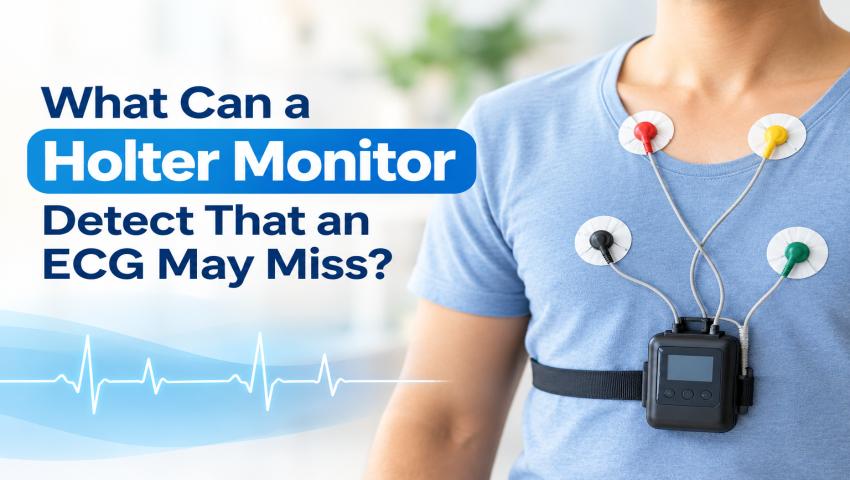
Have you ever felt your heart flutter, race suddenly, or skip a beat? When you visit a clinic, your doctor usually performs a quick chest test called an ECG. However, an ECG only checks your heart for a few seconds. If your symptoms happen after you leave, the test will not catch them. This leads many patients to ask: What can a Holter monitor detect that an ECG may miss? A continuous test helps catch hidden heart rhythm issues that happen at unpredictable times during your day.
This is why doctors recommend a Holter monitoring test. If you want to know what a Holter monitor can detect that routine tests miss, this simple guide breaks it down for you in easy steps.
Holter Monitor vs ECG: Understanding the Key Difference
Understanding these two tests is simple when you look at how long they record your heart:
- Standard ECG: This is like taking a quick photo. It records your heartbeat for less than one minute while you lie still on a bed.
- Holter Monitor: So, what does Holter monitoring mean in daily life? It is a small portable device that records your heart continuously for 24 to 48 hours. It works like a non-stop video recording of your heart while you go about your normal routine.
Consulting an experienced Heart Specialist in Pune helps you decide which test is right for your symptoms. Because a regular ECG is so short, it easily misses heart issues that come and go at random times.
Holter Monitoring: How It Tracks Your Heart Rhythm?
Setting up the monitor is quick, painless, and completely non-invasive:
- A technician places small sticky patches called electrodes on your chest.
- These patches connect to a lightweight recording box that you wear on your belt.
- You go home and carry out your normal daily routine as usual.
- You write down any feelings of dizziness or chest flutters in a simple logbook.
When you feel discomfort, consulting a Chest Pain Specialist in Pune ensures these recorded symptoms are evaluated correctly alongside your daily notes.
Heart Rhythm Problems a Holter Monitor Can Reveal:
Many patients wonder what problems a Holter monitor can detect during regular daily activities. Here are the main issues continuous tracking can catch:
- Irregular Heartbeats (Arrhythmias): Sudden electrical changes where your heart speeds up or slows down for a few seconds.
- Unusual Fast Rhythms (Atrial Fibrillation): Rapid, irregular heartbeats that increase stroke risk if left untreated.
- Very Slow Heartbeats (Bradycardia): Abnormally slow heart rates that cause weakness or fainting spells.
- Hidden Oxygen Shortages: Moments when your heart muscle gets less blood, even if you feel no physical pain.
Can a Holter Monitor Detect Blockages?
A common question patients ask is: Can a Holter monitor detect blockages in heart arteries?
Directly speaking, a Holter monitor does not take images of blocked arteries. A specialized Angiography in Pune is the standard procedure used to visualize physical blockages clearly. However, the Holter monitor picks up abnormal electrical signals caused by poor blood flow. If your Heart Doctor in Pune sees these signals, they will order further tests to confirm blocked blood vessels.
When Holter Monitoring Becomes Important?
Your physician may search for a Holter test near me and recommend this test if you show specific warning signs:
- You faint suddenly or feel lightheaded for no clear reason.
- You feel frequent heart flutters or racing beats while resting.
- You need an advanced non-invasive evaluation like Echocardiography in Pune or a Stress Test in Pune alongside rhythm monitoring.
- Your doctor needs to check how well your heart medicine is working.
- You require a Pacemaker Implantation in Pune and need continuous monitoring before or after the procedure.
Understanding Your Holter Monitor Results:
After your monitoring period ends, you hand back the device and logbook to your clinic. A specialist then analyzes your recorded heartbeats.
- Normal Result: Your heart rate stayed steady and within healthy limits throughout the day and night.
- Abnormal Result: The graph shows unexpected electrical spikes, drops, or missed beats.
If significant blood flow issues are discovered during follow-up checks, a timely Angioplasty in Pune can help restore normal blood circulation to your heart.
Expert Insights on Holter Monitoring From Dr. Kartik Bhosale:
Getting an accurate diagnosis requires an experienced medical specialist. If you are seeking advanced cardiac care, consider consulting the Best Cardiologist in Pune – Dr. Kartik Bhosale.
Dr. Kartik Bhosale is a renowned Interventional Cardiologist in Pune. He completed his MBBS from Seth G. S. Medical College and KEM Hospital, Mumbai, followed by MD Medicine and DM Cardiology from PGIMER, Dr. Ram Manohar Lohia Hospital, New Delhi, where he secured a Gold Medal in Cardiology. He also holds a DrNB in Cardiology. He is a member of the Cardiological Society of India (MCSI), National Academy of Medical Sciences (MNAMS), and also of the Society of Cardiovascular Angiography and Intervention (AMSCAI). His deep clinical background ensures precise diagnostic reporting and trusted care for complex heart conditions.
Holter Monitor FAQs: Common Questions Answered
Most patients wear the device for 24 to 48 hours. If your symptoms happen rarely, a leading Cardiologist in Pune may advise wearing it for up to 7 days.
Yes, you can sleep, work, and do light daily tasks normally. However, you must keep the device completely dry, so bathing or showering is not allowed during the test period.
Yes. The device logs every single heartbeat continuously, allowing your Heart Specialist in Pune to catch silent rhythm changes even when you feel completely fine.
No, the test is entirely painless. You only feel the lightweight recorder box and the sticky patches on your skin.
Press the event button on the device if it has one. Write down the exact time and symptom in your logbook so your Heart Doctor in Pune can check that exact spot on your graph.
Conclusion:
A standard ECG only offers a brief look at your heart, which means periodic rhythm disturbances are easy to miss. A Holter monitoring test records your heart for 24 hours or longer, giving your doctor a complete picture of your cardiac health. Understanding what a Holter monitor can find helps you take control of your well-being early. If you experience unexpected dizziness or chest flutters, consult a trusted Cardiologist in Pune to get your heart evaluated.